LED packaging companies break through the industry adjustment period: Deeply cultivate and segment t
- author:
- 2026-01-21 11:00:01
The impact of global economic shocks and the cyclical downturn in the real estate industry continues to spread, dragging the LED lighting market into a long stage of deep adjustment. TrendForce Consulting predicted in the "Global LED Lighting Market Trends in 2025-Database and Vendor Strategies-2H25" report that the global LED lighting market size will decline by 4.4% year-on-year to US$53.573 billion in 2025. In this context, leading LED packaging companies such as Guoxing Optoelectronics, Hongli Zhihui, Zhaochi Guangyuan, Ruifeng Optoelectronics, Jingke Electronics, Mulinsen, Jingneng Optoelectronics, and Yuanlei Technology, a subsidiary of Furi Electronics, have gradually withdrawn from the fiercely competitive General Lighting Red Sea and accelerated their transformation into high-potential sub-segments such as automotive lighting, plant lighting, and smart lighting.
In addition to shrinking demand, the pressure of rising upstream raw material costs has made business operations even worse. In 2025, the prices of core raw materials such as gold and copper will continue to rise, directly pushing up the manufacturing costs of LED packaging, but this cost pressure will be difficult to pass on to the downstream end market. Yuanlei Technology said that the price increase of raw materials has not triggered a wave of price increases in downstream terminals. Companies can only absorb the cost pressure on their own, resulting in a year-on-year decline in product gross profit margins. It is expected that the oversupply trend in the general lighting market will continue in 2026, and cost competition will become more intense.
In order to get rid of the vicious competition at low-end and low-cost, head-packaging companies have adjusted their strategies: actively abandon the low-value-added low-end market, and seek growth breakthroughs in the industry's downward cycle through technological innovation, application scenario transformation and new track layout. Hongli Zhihui adheres to scientific and technological innovation as the core and continues to optimize product performance in dimensions such as energy conservation, intelligent light efficiency, and health lighting. While stabilizing the main lighting business, it actively expands health lighting, plant lighting, and educational lighting. In the field, to achieve the technological extension from visible light to invisible light, and at the same time, by improving quality and efficiency, it promotes the upgrading of products from illuminating spaces to empowering lives.
Jingke Electronics has repositioned its lighting business as a" high-end value business", abandoned the ineffective consumption of the low-end market, focused on the development of high-tech composite light source solutions, and used diversified technologies and business layout to withstand industry cycle fluctuations. Zhaochi Guangyuan adopts a differentiated strategy of stabilizing the low-end and attacking the high-end, maintaining stable operations in the low-end market, and concentrating core resources on high-end fields; Yuanlei Technology gradually divested its low-end Red Sea business and deeply cultivated customization and high value-added track., follow a steady and steady development path. Overall, packaging companies have reached a consensus: while maintaining the operation of the basic general lighting business, they should tilt resources towards high value-added segments to lay a solid foundation for the long-term transformation of the company.
Head packaging companies are closely following the trend of technological iteration and actively deploying smart lighting products. Hongli Zhihui lists intelligent interaction as its core direction and launches a series of natural light products to achieve full spectral coverage of 1800K to 12000K, which can accurately simulate the changes of natural light rhythm. This technology has been implemented in smart office scenarios, and automatically adjusts the light color through AI sensors., truly realizing that light changes on demand. Guoxing Optoelectronics accurately captured the recovery opportunities of smart home lighting and released the Natural Light 4.1 series products at the 2025 Guangya Exhibition, supporting the launch of enabling version and sleeping version dynamic intelligent light environment solutions, as well as smart lighting colorful, monochromatic, white light series and white light EMC3030 dual color temperature device, and recently launched the 5050 three-in-one light color light device to enrich the product matrix to meet the needs of multi-scene intelligent lighting. In response to the popularization trend of the Internet of Things and AI technology, Zhaochi Optoelectronics has developed RGB and RGBW series color light devices, which support multi-channel independent control and can realize dynamic switching of 16 million colors. It is widely used in ambient lighting, commercial spaces and human-computer interaction systems.
Many companies said that LED lighting products are upgrading in the direction of" light quality + emotional atmosphere + intelligent control". In the future, they will further promote the deep integration of LED with sensing technology, intelligent drive, and optical design to create a high-threshold composite light source solution.
In 2025, although fluctuations in the international situation will suppress new and replacement demand for agricultural lighting, driven by European energy-saving regulations and the popularization of high-efficiency photosynthetic photon flux efficiency (PPE) products, TrendForce Consulting predicts that the market size will increase throughout the year. It will increase to US$1.366 billion, a year-on-year increase of 3.9%. In this context, packaging companies have increased their efforts in plant lighting technology research and development and product innovation.
Guoxing Optoelectronics has listed plant lighting as a key track and built" a" full-chain service capability of device-system-solution. The packaged devices cover mainstream size such as 2835, 3030, and 3535. The maximum length of a single PPE is 3.2μ mol/J, and the life (L70) exceeds 100,000 hours. Recently, it has released the" Intelligent Farming Star" AI planting ecosystem, which integrates LED light sources, sensors and edge computing technology to collect temperature, humidity, lighting and other data in real time and automatically optimize the light formula. Mulinsen launched high-efficiency light sources specially designed for plant lighting at the 2025 Guangya Exhibition, including 3030 flip chip EVO lamp beads (PPE 3.15@65mA) and 3535 ceramic 660nm lamp beads (PPE 4.6@700mA).
Hongli Zhihui exhibited SMD 3030 series, outdoor high light efficiency series and plant lighting high PPE series products. Among them, the ceramic plant lighting light series-SPG2R-6.24 products have ultra-high deep red light efficiency, with PPE values reaching 5.05μ mol/J@350mA and 4.53μ mol/J@700mA respectively. They have strong thermal stability and excellent vulcanization resistance. The Q90 life exceeds 50,000 hours, and can adapt to harsh indoor agricultural environments such as high humidity. In the first half of 2025, Jinko Electronics relied on its efforts on subdivided tracks such as plant lighting and special lighting. The revenue of its high-end lighting business reached 340 million yuan. The photoelectric conversion efficiency of its plant lighting products continues to be upgraded. The plan covers the entire cycle of crops from breeding to harvest, relying on core flip chip technology to provide customized spectral solutions with high light efficiency and high cost performance. In the future, it will further deploy high-reliability, high-brightness and high-power LED devices and modules for outdoor, plant and special lighting.
For the harsh use environment of plant lighting, Zhaochi Guangyuan has launched high-efficiency and high-reliability product lines such as 3030, 2835, and EMC3030. They have excellent high temperature resistance, moisture resistance, and UV resistance, which can effectively control long-term operation light fading and reduce maintenance costs. Yuanlei Technology has built a full-specification plant lighting packaging product matrix, covering 2835 white light, 3030 flip chip white light and short-wave white light, 3737 660nm/730nm red light, 3535 ceramic 660nm/730nm red light and other products. It can provide white, red, green, blue basic light color and RGB full-color solutions. It also supports violet light, pink light and special spectrum products for plant growth. With chips and PCT/PPA red copper brackets, Al ˇ O/ALN gold plating/silver substrate process, Achieve the core advantages of small size, high brightness, excellent heat dissipation, and strong light color consistency to meet the supplementary light needs of crops at various growth stages.
TrendForce Consulting predicts that with the iteration of high-performance plant lighting products and increased investment in emerging technology agriculture, the global LED plant lighting market is expected to increase to US$1.769 billion in 2029, with a compound growth rate of 6.1% from 2024 to 2029. Packaging companies will continue to promote plant lighting to empower agricultural modernization and intelligence through technological innovation and product upgrades.
Corporate performance data intuitively confirms this trend: in 2025, many domestic LED packaging companies will achieve high growth in the automotive business. Jinko Electronics 'automotive intelligent vision business grew by more than 100% year-on-year, becoming the company's largest source of increase in performance. It believes that smart lights have gradually become standard for new cars, and the demand for vehicle gauge LEDs in vehicle manufacturers continues to rise; Ruifeng Optoelectronics' vehicle LED and vehicle backlight business increased by 86% year-on-year in the first half of the year, becoming the core growth driver; Hongli Zhihui lists automotive lighting as one of its two main businesses. In the first half of 2025, the revenue of this business will be nearly 440 million yuan, a year-on-year increase of 51%. The proportion of revenue will increase from 15.26% in the first half of 2024 to 21.72%; Jufei Optoelectronics 'automotive LED business is growing rapidly and has entered the supply chains of many well-known domestic and foreign automobile companies, with sufficient order reserves; Mulinsen will enter the automotive lighting LED field in 2025 and successfully open the after-mounted lamp market.
Behind this round of growth is the supply chain transformation jointly promoted by the expansion of China's new energy automobile industry and the price war of automobile companies. The normalization of the price game in the automobile market forces entire vehicle manufacturers to control supply chain costs and accelerate the localization of car lights. Relying on their rapid response capabilities and continuously improved technical strength, domestic packaging companies have successfully broken through the Tier 1 supply chain pattern monopolized by international giants and seized market share.
Resisting downward pressure from the industry through technological innovation and efficiency improvement.
In 2025, the lighting business of LED packaging companies will face multiple challenges. The growth momentum of the general lighting sector, which once served as the foundation of the industry, has exhausted, making it difficult to effectively stimulate demand for packaged products. Most companies maintain conservative predictions about future market trends. Zhaochi Guangyuan bluntly said that due to the transmission impact of the continued downturn in the lighting market from 2024 to 2025, the industry environment may further deteriorate in 2026; Yuanlei Technology also believes that the weak state of the general lighting market may become the norm, and the oversupply pattern caused by the lack of consumers is difficult to fundamentally improve in the short term; Ruifeng Optoelectronics pointed out that general lighting has entered a stage of parallel stock competition and structural adjustment, and the growth rate has stabilized. In the future, the focus of industry competition will shift from scale expansion to value improvement and technological iteration in market segments.In addition to shrinking demand, the pressure of rising upstream raw material costs has made business operations even worse. In 2025, the prices of core raw materials such as gold and copper will continue to rise, directly pushing up the manufacturing costs of LED packaging, but this cost pressure will be difficult to pass on to the downstream end market. Yuanlei Technology said that the price increase of raw materials has not triggered a wave of price increases in downstream terminals. Companies can only absorb the cost pressure on their own, resulting in a year-on-year decline in product gross profit margins. It is expected that the oversupply trend in the general lighting market will continue in 2026, and cost competition will become more intense.
In order to get rid of the vicious competition at low-end and low-cost, head-packaging companies have adjusted their strategies: actively abandon the low-value-added low-end market, and seek growth breakthroughs in the industry's downward cycle through technological innovation, application scenario transformation and new track layout. Hongli Zhihui adheres to scientific and technological innovation as the core and continues to optimize product performance in dimensions such as energy conservation, intelligent light efficiency, and health lighting. While stabilizing the main lighting business, it actively expands health lighting, plant lighting, and educational lighting. In the field, to achieve the technological extension from visible light to invisible light, and at the same time, by improving quality and efficiency, it promotes the upgrading of products from illuminating spaces to empowering lives.
Jingke Electronics has repositioned its lighting business as a" high-end value business", abandoned the ineffective consumption of the low-end market, focused on the development of high-tech composite light source solutions, and used diversified technologies and business layout to withstand industry cycle fluctuations. Zhaochi Guangyuan adopts a differentiated strategy of stabilizing the low-end and attacking the high-end, maintaining stable operations in the low-end market, and concentrating core resources on high-end fields; Yuanlei Technology gradually divested its low-end Red Sea business and deeply cultivated customization and high value-added track., follow a steady and steady development path. Overall, packaging companies have reached a consensus: while maintaining the operation of the basic general lighting business, they should tilt resources towards high value-added segments to lay a solid foundation for the long-term transformation of the company.
Focus on segments and explore structural growth opportunities
Although the general lighting market is chilly, segments such as smart lighting and plant lighting still maintain growth vitality and have become a key starting point for packaging companies to break through. TrendForce Consulting believes that in the context of the continued decline of general lighting, such high value-added tracks are constantly releasing growth potential and becoming the core direction for LED packaging companies to break through the Red Sea competition in 2025.AI empowers smart lighting, and demand continues to heat up,
benefiting from the advancement of global energy conservation and emission reduction policies, the upgrading of consumer demand for dynamic dimming and toning and human health lighting, the decline in research and development costs of superimposed technologies, the implementation of new generation compatible protocols such as Matter, and the integration of AI algorithms. Application, the popularity of the smart lighting market has steadily picked up. TrendForce Consulting observed that in 2025, the penetration of LED smart lighting technology will accelerate, and the demand for products such as smart bulbs, ceiling lamps, floor lamps and light strips will continue to grow.Head packaging companies are closely following the trend of technological iteration and actively deploying smart lighting products. Hongli Zhihui lists intelligent interaction as its core direction and launches a series of natural light products to achieve full spectral coverage of 1800K to 12000K, which can accurately simulate the changes of natural light rhythm. This technology has been implemented in smart office scenarios, and automatically adjusts the light color through AI sensors., truly realizing that light changes on demand. Guoxing Optoelectronics accurately captured the recovery opportunities of smart home lighting and released the Natural Light 4.1 series products at the 2025 Guangya Exhibition, supporting the launch of enabling version and sleeping version dynamic intelligent light environment solutions, as well as smart lighting colorful, monochromatic, white light series and white light EMC3030 dual color temperature device, and recently launched the 5050 three-in-one light color light device to enrich the product matrix to meet the needs of multi-scene intelligent lighting. In response to the popularization trend of the Internet of Things and AI technology, Zhaochi Optoelectronics has developed RGB and RGBW series color light devices, which support multi-channel independent control and can realize dynamic switching of 16 million colors. It is widely used in ambient lighting, commercial spaces and human-computer interaction systems.
Many companies said that LED lighting products are upgrading in the direction of" light quality + emotional atmosphere + intelligent control". In the future, they will further promote the deep integration of LED with sensing technology, intelligent drive, and optical design to create a high-threshold composite light source solution.
Plant lighting is growing against the trend, and technological innovation drives expansion.
LED plant lighting is a popular segment of the track in the past two years. Although the market has fluctuated greatly in the past, with the continuous expansion of application scenarios such as greenhouses and vertical farms, coupled with the European market's energy-saving regulations, driven by demand growth, has gradually gotten rid of the single dependence on the cultivation of special crops and entered a stage of diversified demand. TrendForce Consulting data shows that the LED plant lighting market will increase to US$1.315 billion in 2024, mainly due to the recovery of greenhouse lighting demand and the new volume brought by the construction of small and medium-sized vertical farms.In 2025, although fluctuations in the international situation will suppress new and replacement demand for agricultural lighting, driven by European energy-saving regulations and the popularization of high-efficiency photosynthetic photon flux efficiency (PPE) products, TrendForce Consulting predicts that the market size will increase throughout the year. It will increase to US$1.366 billion, a year-on-year increase of 3.9%. In this context, packaging companies have increased their efforts in plant lighting technology research and development and product innovation.
Guoxing Optoelectronics has listed plant lighting as a key track and built" a" full-chain service capability of device-system-solution. The packaged devices cover mainstream size such as 2835, 3030, and 3535. The maximum length of a single PPE is 3.2μ mol/J, and the life (L70) exceeds 100,000 hours. Recently, it has released the" Intelligent Farming Star" AI planting ecosystem, which integrates LED light sources, sensors and edge computing technology to collect temperature, humidity, lighting and other data in real time and automatically optimize the light formula. Mulinsen launched high-efficiency light sources specially designed for plant lighting at the 2025 Guangya Exhibition, including 3030 flip chip EVO lamp beads (PPE 3.15@65mA) and 3535 ceramic 660nm lamp beads (PPE 4.6@700mA).
Hongli Zhihui exhibited SMD 3030 series, outdoor high light efficiency series and plant lighting high PPE series products. Among them, the ceramic plant lighting light series-SPG2R-6.24 products have ultra-high deep red light efficiency, with PPE values reaching 5.05μ mol/J@350mA and 4.53μ mol/J@700mA respectively. They have strong thermal stability and excellent vulcanization resistance. The Q90 life exceeds 50,000 hours, and can adapt to harsh indoor agricultural environments such as high humidity. In the first half of 2025, Jinko Electronics relied on its efforts on subdivided tracks such as plant lighting and special lighting. The revenue of its high-end lighting business reached 340 million yuan. The photoelectric conversion efficiency of its plant lighting products continues to be upgraded. The plan covers the entire cycle of crops from breeding to harvest, relying on core flip chip technology to provide customized spectral solutions with high light efficiency and high cost performance. In the future, it will further deploy high-reliability, high-brightness and high-power LED devices and modules for outdoor, plant and special lighting.
For the harsh use environment of plant lighting, Zhaochi Guangyuan has launched high-efficiency and high-reliability product lines such as 3030, 2835, and EMC3030. They have excellent high temperature resistance, moisture resistance, and UV resistance, which can effectively control long-term operation light fading and reduce maintenance costs. Yuanlei Technology has built a full-specification plant lighting packaging product matrix, covering 2835 white light, 3030 flip chip white light and short-wave white light, 3737 660nm/730nm red light, 3535 ceramic 660nm/730nm red light and other products. It can provide white, red, green, blue basic light color and RGB full-color solutions. It also supports violet light, pink light and special spectrum products for plant growth. With chips and PCT/PPA red copper brackets, Al ˇ O/ALN gold plating/silver substrate process, Achieve the core advantages of small size, high brightness, excellent heat dissipation, and strong light color consistency to meet the supplementary light needs of crops at various growth stages.
TrendForce Consulting predicts that with the iteration of high-performance plant lighting products and increased investment in emerging technology agriculture, the global LED plant lighting market is expected to increase to US$1.769 billion in 2029, with a compound growth rate of 6.1% from 2024 to 2029. Packaging companies will continue to promote plant lighting to empower agricultural modernization and intelligence through technological innovation and product upgrades.
Automotive lighting:
Compared with the steady growth of smart lighting and plant lighting, automotive lighting has become the core engine for LED packaging companies to withstand the industry cycle and achieve rapid growth. Each company continues to increase resource investment. Driven by the explosive growth of new energy vehicles and localized substitution of supply chains, automotive lighting is gradually becoming an important support and new profit growth point for the domestic LED industry. Even in the overall economic downturn, it still maintains strong growth trend.Corporate performance data intuitively confirms this trend: in 2025, many domestic LED packaging companies will achieve high growth in the automotive business. Jinko Electronics 'automotive intelligent vision business grew by more than 100% year-on-year, becoming the company's largest source of increase in performance. It believes that smart lights have gradually become standard for new cars, and the demand for vehicle gauge LEDs in vehicle manufacturers continues to rise; Ruifeng Optoelectronics' vehicle LED and vehicle backlight business increased by 86% year-on-year in the first half of the year, becoming the core growth driver; Hongli Zhihui lists automotive lighting as one of its two main businesses. In the first half of 2025, the revenue of this business will be nearly 440 million yuan, a year-on-year increase of 51%. The proportion of revenue will increase from 15.26% in the first half of 2024 to 21.72%; Jufei Optoelectronics 'automotive LED business is growing rapidly and has entered the supply chains of many well-known domestic and foreign automobile companies, with sufficient order reserves; Mulinsen will enter the automotive lighting LED field in 2025 and successfully open the after-mounted lamp market.
Behind this round of growth is the supply chain transformation jointly promoted by the expansion of China's new energy automobile industry and the price war of automobile companies. The normalization of the price game in the automobile market forces entire vehicle manufacturers to control supply chain costs and accelerate the localization of car lights. Relying on their rapid response capabilities and continuously improved technical strength, domestic packaging companies have successfully broken through the Tier 1 supply chain pattern monopolized by international giants and seized market share.
TAG:
Guess you want to see it


Popular information
-
CEO of TV IKLAN Group, Indonesia's largest media company, led a delegation to inspect MNLED and the

-
Raontech achieves a breakthrough in color Micro LED backplane technology, leading the transformation
-
Thirty Years of Liard: Industrial Game and Strategic Breakthrough Behind Light and Shadow

-
AU Optronics: Innovation pioneer in CES 2025 smart cockpit design
-
Strategic cooperation between Liard and Hebei Steel Valley: The market breakthrough battle behind th

-
Vogel Group's GCP Mini LED light panels are mass-produced, and the industrialization of glass circui

-
Market worries and challenges under the aura of "intelligence" manufacturing of Zhaochi shares

-
AUO Group: Intelligent leadership in new changes in medical care and building a new healthy ecosyste
-
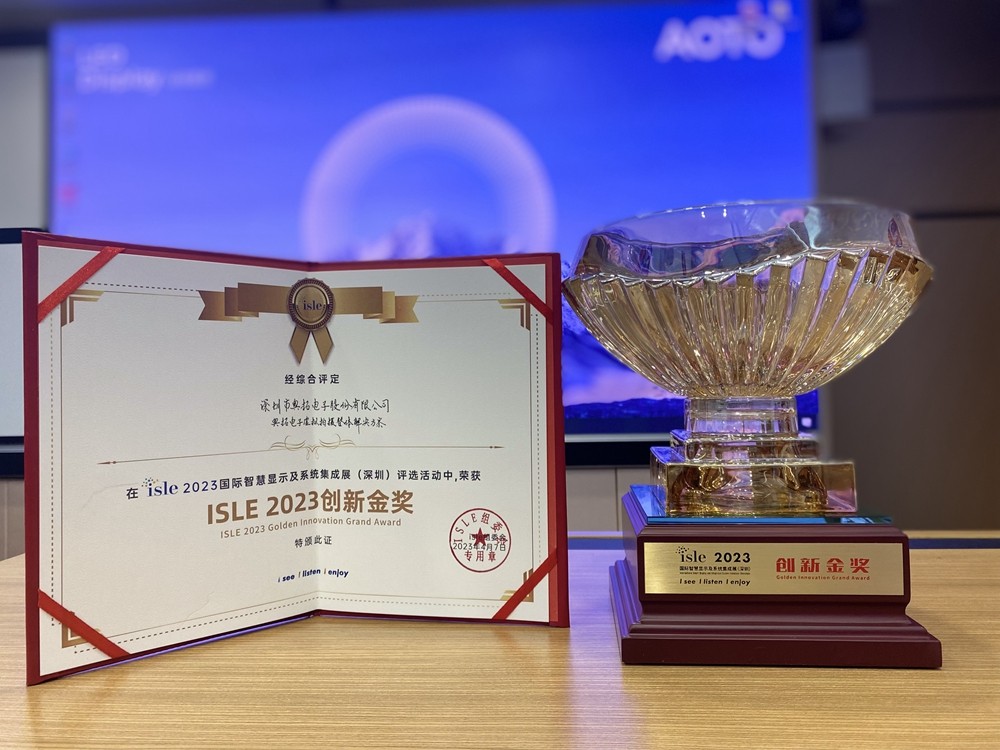
Good news! Alto Electronics wins four ISLE 2023 awards
-
Micro LED technology innovation boom is surging: many companies have made patent breakthroughs focus

the charts
- CEO of TV IKLAN Group, Indonesia's largest media company, led a delegation to inspect MNLED and the
- Innolux joins hands with Yuantai, TPV and others to introduce large size color electronic paper into
- Xida Electronics signs a strategic cooperation agreement with Changbai Mountain Chixi District Manag
- Liard joins hands with "Three-Body" to open a new era of science fiction drama in China
- Zhaochi Semiconductor joins hands with Li Xing Semiconductor. Want to do big things?
- Zhou Ming joins hands with the Guangdong Basketball Association to produce another masterpiece! The
- ISE2023 Abbison's first exhibition in the new year has received frequent good news, and the immersiv
- Samsung Display and APS "work together" to create 3500ppi Micro OLED
- Zhouming Technology and Perfect World officially reached an educational ecological partnership!
- Longli Technology:Mini-LED has been shipped in batches to some in-vehicle customers, VR customers, e